Archive for the ‘Food & Culinary Arts’ Category

Hazardous is a Scary Word

2019/02/26

The Oxford English Dictionary defines HAZARDOUS (adj.) as 1) fraught with hazards or risk; dangerous; risky 2) of a person: given to risk-taking; reckless; adventurous 3) of the nature of the game of hazard; dependent on chance, and 4) that is or represents a hazard to human or animal health; that is damaging to the environment.  A HAZARDOUS MATERIAL (n.) isany of various substances considered to be especially dangerous to humans, the environment, etc., if not handled, used, or stored in a particular way and HAZARDOUS WASTE (n.) is waste, esp. industrial waste, that is potentially harmful to human health or to the environment and which requires special facilities for its disposal.

Cigarette smoking harms nearly every organ of the body, causes many diseases, and reduces the health of smokers in general.  It is the leading preventable cause of death in the United States as evidenced by causing more deaths each year than the following five causes combined: 1) human immunodeficiency virus (HIV), 2) illegal drug use,
3) alcohol use, 4) motor vehicle injuries, and 5) firearm-related incidents.  More than 10 times as many U.S. citizens have died prematurely from cigarette smoking than have died in all the wars fought by the United States.

Clearly, cigarette smoking is hazardous to your health, but what about food?  The Food and Drug Administration (FDA, a federal agency of the Department of Health and Human Services) used to use the term “potentially hazardous foods” to describe many of them.  Of course meat, poultry and fish need special handling but what about a leafy green salad and cut tomatoes?  Yes, even a salad!

A potentially hazardous food (PHF) or time/temperature control for safety food (TCS) is defined in terms of whether or not it requires time/temperature control for safety to limit pathogen growth or toxin formation.  The list of TCS foods may surprise you.  Basically, if you need to keep a food item in the refrigerator, it’s a TCS food.  That means everything from milk and cheese and eggs and meat, all the way down to cooked rice.  Why use such a scary term, potentially hazardous, for everyday food items?  Why try to associate these common foods with cancer, Three Mile Island and Chernobyl?

Here is the story about TCS foods.

The FDA publishes the Food Code, a model that assists food control jurisdictions at all levels of government by providing them with a scientifically sound technical and legal basis for regulating the retail and food service segment of the industry (restaurants and grocery stores and institutions such as nursing homes). Local, state, tribal, and federal regulators use the FDA Food Code as a model to develop or update their own food safety rules and to be consistent with national food regulatory policy.

Between 1993 and 2001, the Food Code was issued every two years. With the support of the Conference for Food Protection (CFP), FDA decided to move to a four-year interval between complete Food Code editions. During the interim period between full editions, FDA may publish a Food Code Supplement that updates, modifies, or clarifies certain provisions. The 2005 Food Code was the first full edition published on the new four-year interval, and it was followed by the Supplement to the 2005 Food Code, which was published in 2007. The 2017 Food Code is the most recent full edition published by FDA.

In 2009, the FDA Food Code had a definition of Potentially Hazardous Food on page 15:

Potentially hazardous food (time/temperature control for safety food)
means a food that requires time/temperature control for safety (TCS) to limit
pathogenic microorganism growth or toxin formation.

Following issuance of the final report “Evaluation and Definition of Potentially Hazardous Foods” (Technologists, 2010) by the Institute of Food Technologists (IFT) on December 31, 2001 the recommendation was made to change the name of “potentially hazardous foods” or “PHF” to “temperature control for safety food” or “TCS”. The report advised that use of both terms (e.g. PHF/TCS) during a transition phase would facilitate migration from one term to the next. Now over a decade since the IFT report, the transition term has been in common use in the FDA Food Code since 2005.

In 2012, the CFP made a recommendation to the FDA to change the definition of PHF/TCS to TCS.

The definition of “Potentially Hazardous Food (Time/Temperature Control for Safety Food)”, abbreviated PHF/TCS in the FDA Food Code, has now been in common use for over six years. While it has served its purpose for introducing the new term, the time has come to complete the migration to the new definition. The definition and abbreviation for “Potentially Hazardous Food (Time/Temperature Control for Safety Food)” or “PHF/TCS” should be modified to drop the reference to “potentially hazardous food” and “PHF”. Instead, the definition should read “Time/Temperature Control for Safety Food” abbreviated as “TCS”.

The Conference recommends that a letter be sent to the FDA requesting the following change to the 2009 Food Code (as modified by the Supplement issued in 2011):

Replace the current definition “Potentially Hazardous Food (Time/Temperature Control for Safety Food)” abbreviated as “PHF/TCS” with the new term “Time/Temperature Control for Safety Food” abbreviated “TCS” throughout the entire FDA Food Code.

The FDA acted on this 2012 recommendation and dropped the PHF term throughout the 2013 FDA Food Code.  The FDA Food Code is the model upon which states and other jurisdictions base their food-related laws and regulations.

However, now over 5-years later, neither the State of Maryland nor Montgomery County has done the same.


REFERENCES accessed February 23, 2019.

Oxford English Dictionary
hazardous, adj.; hazardous material, n.; hazardous waste, n.

Health Effects of Cigarette Smoking, Centers for Disease Control and Prevention (CDC)
https://www.cdc.gov/tobacco/data_statistics/fact_sheets/health_effects/effects_cig_smoking/

Conference for Food Protection, Council I, 2012 Scribe Packet, Issue Number: Council I 004
Change definition of PHF/TCS to TCS
http://www.foodprotect.org/issues/packets/2012ScribePacket/issues/I_004.html

MARYLAND Food Handlers List of TCS Foods
https://www.mdfoodhandlers.com/Content.aspx?PageName=TCS

United States Food and Drug Administration (FDA) Food Code
https://www.fda.gov/food/GuidanceRegulation/retailfoodprotection/foodcode/

2009 FDA Food Code
https://wayback.archive-it.org/7993/20170404235435/https://www.fda.gov/downloads/Food/GuidanceRegulation/UCM189448.pdf

2013 FDA Food Code and Supplement
https://www.fda.gov/downloads/Food/GuidanceRegulation/RetailFoodProtection/FoodCode/UCM374510.pdf
https://www.fda.gov/downloads/Food/GuidanceRegulation/RetailFoodProtection/FoodCode/UCM451981.pdf

FDA Food Code 2017
https://www.fda.gov/downloads/Food/GuidanceRegulation/RetailFoodProtection/FoodCode/UCM595140.pdf

FDA Training Resources, Program Information Manual, Retail Food Protection Training Resources
https://www.fda.gov/Food/GuidanceRegulation/RetailFoodProtection/IndustryandRegulatoryAssistanceandTrainingResources/ucm113843.htm
Page Last Updated: 01/29/2018

Code of Maryland (COMAR) Regulations (Last Updated: July 29,2016)
Title 10. Department of Health & Mental Hygiene Subtitle 15. FOOD, Part 3.
Chapter 10.15.03. Food Service Facilities
http://mdrules.elaws.us/comar/10.15.03

Chapter 15. Eating And Drinking Establishments – Montgomery County
http://montgomeryco-md.elaws.us/code/core_ch15_15.00.01

Help Reduce Food Waste

2018/12/10

Tom Vilsack was Secretary of Agriculture from 2009 until 2017. In 2013 he called on both the public sector and private industry to reduce food waste. He said the USDA was going to:

  • “Develop a nationwide social media campaign with our partners to focus on precisely what the use by date and the sell by date means so that folks don’t discard food prematurely.”
  • “Continue to use our social media to develop a new food storage application that will give people up to date information on how and best to store food and what constitutes safe or unsafe food.”
  • “Work with our school lunch program to reduce food waste in our schools.”
  • “Look for ways we can increase donations of imported fresh produce that for whatever reason don’t meet our marketing order standards.”

VILSACK SAID THAT WASTING FOOD IS A MORAL ISSUE
IN A NATION WHERE THERE ARE HUNGRY PEOPLE.

He said that “part of this is thinking about portion sizes.”

How many times have you gone to a restaurant and have been served much more than you can eat? My wife has a solution. She literally cuts her meal in half before she starts and eats exactly half — what will-power! On other occasions, we order two soups or salads and split one entrée so we have no leftovers.

Vilsack also said that “understanding precisely what the food safety rules are so that you are not discarding food that would otherwise would be healthy and nutritious for your family.”

How many times have you brought home leftovers to weeks later find it hidden in the back of the fridge?  Our solution: take a piece of masking tape and date the container.  Depending on the type of food, throw it out within 3-4 days or a week if it hasn’t been eaten in a timely manner.  Stores do stock rotation based on “best by” dates.  You can do the same in your refrigerator and freezer with your store-bought or leftover food.

There are other things you can do to keep your family safe from foodborne illness.  As the USDA, FDA, CDC and Ad Council public service announcements say: Clean, Separate, Cook and Chill.

4-simple-steps
http://www.foodsafety.gov


In 2016 Vilsack said “Forty percent of the food grown in the country is wasted. That amounts to 133 billion pounds of food wasted. That is billion with a B. Considering we have about 45 million people receiving assistance through SNAP, I believe this is a tremendous opportunity for us to take a closer look at our food chain, and figure out a way to ensure that food grown in this country reaches the dinner table and not the trashcan.”

At a food waste summit in 2016, Secretary Vilsack commented that “avoiding food waste loss could save U.S. families on average $1,500 a year, and limiting food waste globally could help prevent hunger and malnourishment in the 825 to 850 million people worldwide who are not getting adequate food.”He went on to say “Tackling food waste in this country is, and should be a nonpartisan issue that will be most successful by engaging everyone in the food chain, from the field to the table. It will take the collaboration of all stakeholders to be successful.”


So I ask: What are YOU doing to help reduce food waste?

SOURCES

Ending Food Waste, David Robert Lambert, June 7, 2013
https://lambertdrl.wordpress.com/2013/06/07/ending-food-waste/

Food Waste from Field to Table, U.S. House of Representatives Hearing, 114 Congress,
Serial No. 114-52, May 25, 2016 (accessed 12/10/2018)
https://www.gpo.gov/fdsys/pkg/CHRG-114hhrg20309/html/CHRG-114hhrg20309.htm


Expiration Dates, or lack thereof, David Robert Lambert, November 7, 2018
https://lambertdrl.wordpress.com/2018/11/07/expiration-dates-or-lack-thereof/

Organizations Exempt from Kitchen Licensing

2018/11/29

I knew of “exempt”, meaning a homeless lunch program or soup kitchen, but upon further examination, the State of Maryland’s definition is much broader.

My read on this is that any 501(c)(3) nonprofit, including houses of worship of any denomination or faith, can prepare/cook and demo/taste/serve any type of food (TCS as well as non-TCS) to the public, without the need of a licensed kitchen, as long as this is not done more than 4 days a week.

Of course this needs to be verified and all the i’s dotted and t’s crossed with the health department, but I think I have uncovered an important piece of information, especially with regards to cooking demonstrations. It is very encouraging that the Montgomery County (Maryland) Health Department Inspection database has an “Excluded organization” category.

If secular nonprofit organizations like the American Legion, VFW and Moose Lodge are exempt from kitchen licensing, then all churches, religious organizations as well as clergy should be also.

REFERENCES

MARYLAND Food Handlers List of TCS Foods
https://www.mdfoodhandlers.com/Content.aspx?PageName=TCS

IRS Publication 1828 Tax Guide for Churches & Religious Organizations
Congress has enacted special tax laws that apply to churches, religious organizations and ministers in recognition of their unique status in American society and of their rights guaranteed by the First Amendment of the Constitution of the United States. Churches and religious organizations are generally exempt from income tax and receive other favorable treatment under the tax law.
https://www.irs.gov/pub/irs-pdf/p1828.pdf

Code of Maryland (COMAR) Regulations (Last Updated: July 29,2016)
Title 10. Department of Health & Mental Hygiene Subtitle 15. FOOD, Part 3.
Chapter 10.15.03. Food Service Facilities
http://mdrules.elaws.us/comar/10.15.03

COMAR Sec. 10.15.03.02. Definitions – Code of Maryland Regulations
(28a) “Excluded organization” means a bona fide nonprofit fraternal, civic, war veterans’, religious, or charitable organization or corporation that does not serve food to the public more often than 4 days per week, except that once a year an organization may serve food to the public for up to 14 consecutive days.
http://mdrules.elaws.us/comar/10.15.03.02

There are currently 7 excluded organizations listed by the Montgomery County Health Department:
o AMERICAN LEGION #086
o BAUER DRIVE COMMUNITY CENTER
o BLAKE BOOSTER CLUB CONCESSION STAND
o GWENDOLYN E. COFFIELD COMM. CENTER
o POTOMAC COMMUNITY CENTER
o VFW TAKOMA POST 350
o WHEATON MOOSE LODGE #1775
https://stat.montgomerycountymd.gov

Expiration Dates, or lack thereof

2018/11/07

The U.S. Department of Agriculture (USDA) estimates as much as 40 percent of all food grown, produced and shipped in the U.S. will never be eaten.

A confusing system of food labeling has led to consumers throwing away billions of dollars worth of food products every year, and much of that food is completely safe to eat.

“A lot of people confuse quality and safety,” food research scientist Linda Harris said. “That’s a big problem.”

Harris is the chair of Food Science and Technology at the University of California, Davis. She said most food is perfectly safe to eat past the date on the label. That’s because most dates on food are not “expiration” dates. They actually tell consumers when peak freshness or flavor drops off.

“The date is meant to signal quality,” Harris said. “It’s not a safety issue.”  “It’s not illegal to sell a product past its ‘best-by’ date,” she said.

The only items required by federal law to be labeled for expiration are infant formula and some baby foods; some states also mandate pulling dairy from store shelves on the expiration date.  The actual term “Expiration Date” refers to the last date a food should be eaten or used.

The labeling “sell by” tells the store how long to display the product for sale.  This is basically a guide for the retailer, so the store knows when to pull the item.  The “sell by” date is the last day the item is at its highest level of quality, but it will still be edible for some time after.

“Best if used by (or before)” date. This refers strictly to quality, not safety. This date is recommended for best flavor or quality. It is not a purchase or safety date.

Ref 1: ‘Use By’ Dates on Food Create Consumer Confusion, June 19, 2018
https://www.nbcchicago.com/news/local/Use-By-Dates-on-Food-Create-Consumer-Confusion-485818791.html

Ref 2: Do Food Expiration Dates Really Matter? – WebMD
https://www.webmd.com/a-to-z-guides/features/do-food-expiration-dates-matter

Ref 3: Wasted: How America Is Losing Up to 40 Percent of Its Food from Farm to Fork to Landfill
https://www.nrdc.org/resources/wasted-how-america-losing-40-percent-its-food-farm-fork-landfill

Ref 4: USDA Office of the Chief Economist
https://www.usda.gov/oce/foodwaste/faqs.htm


Food Day — Eat Green

2015/10/20

20151020_130840_Pumpkins

And you thought these were just for decorations!

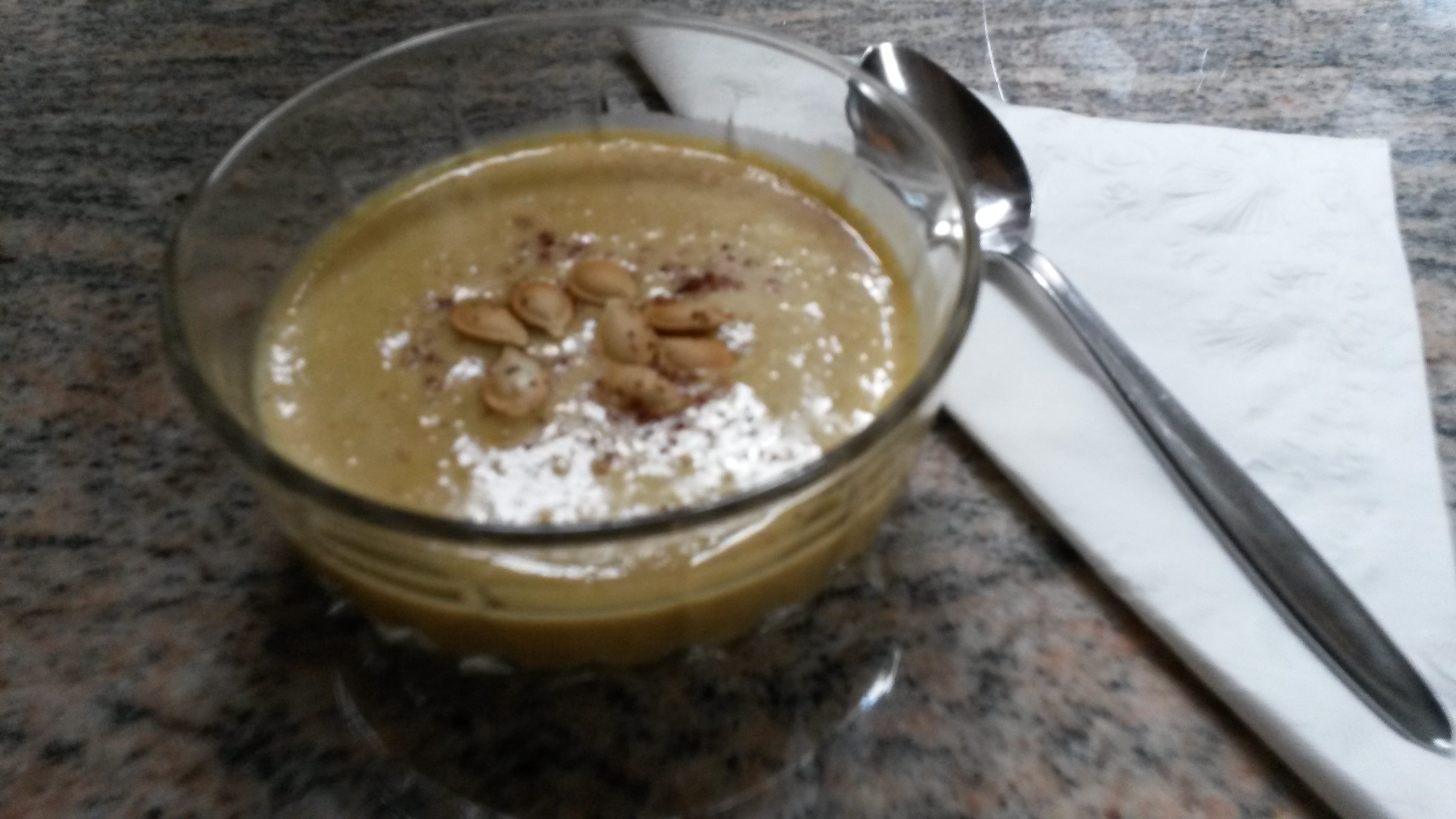
MINI-PUMPKIN SOUP

  1. Slice pumpkins and remove seeds (reserve seeds for garnish)
  2. Bake pumpkins in foil-covered dish with 1″ of water for 1-hour at 350 degrees
  3. Meanwhile, separate the seeds from the fibrous strands and soak in salt water for 15 minutes
  4. Bake seeds in toaster oven for 30 minutes at 325 degrees or until they are browned and crunchy
  5. Scrape pumpkin meat away from the skin (mini-pumpkins above made 2.5 cups)
  6. Make roux of 1/2 stick butter, 1/4 cup flour, 1 cup vegetable bouillon, 1 cup milk or half & half
  7. Add pumpkin meat, season with 1/2 t. salt, 1/2 t. ground cinnamon, 1/2 t. ground nutmeg 1/4 t. ground cloves to taste
  8. Transfer to blender and puree; if too thick, add more milk or half & half
  9. Return to roux pot to reheat or store soup in the fridge and reheat later or serve chilled
  10. Serve in small bowls; garnish with toasted pumpkin seeds and a sprinkle of nutmeg or cinnamon to taste

20151020_145759_Soup

Food Day hashtags: #greenmeal #foodday2015 #EatGreenMoCo

2015 Food Day in Montgomery County, Maryland

2015/10/16

Food Day Logo

In honor of Food Day this year (officially held on Saturday, October 24th), the Montgomery County Food Council’s Food Literacy Working Group encourages local residents to cook a fresh, healthy, vegetable-centered meal and enjoy it with your family, friends, colleagues, or neighbors. Snap and share a photo of your meal during the week leading up to Food Day and join our media campaign!

The Food Council will be tweeting, gramming, and posting on Facebook and our blog the week of October 20th to share our commitment to this effort. Please help us raise awareness on social media using the official Food Day hashtags, #greenmeal and #foodday2015, and tagging @mocofoodcouncil. Throughout October we will feature resources, recipes, and local Food Day event information on our website and Facebook, Twitter, and Instagram accounts. Please follow us and help to get others involved by sharing, liking, and retweeting our Food Day posts and photos.

Please share this widely! We’d love to see everyone- schools, farms, businesses, hospitals, governmental groups, non-profits, and individuals- participate and spread the word about greening our plates to improve our health and the health of our planet.

Follow us and share!:
Web: http://www.mocofoodcouncil.org
Facebook: facebook.com/mocofoodcouncil
Twitter: MoCoFoodCouncil
Instagram: MoCoFoodCouncil

Ending Food Waste

2013/06/07

Agriculture Secretary Tom Vilsack is calling on both the public sector and private industry to reduce food waste.  He said the USDA is going to:

  • “Develop a nationwide social media campaign with our partners to focus on precisely what the use by date and the sell by date means so that folks don’t discard food prematurely.”
  • “Continue to use our social media to develop a new food storage application that will give people up to date information on how and best to store food and what constitutes safe or unsafe food.”
  • “Work with our school lunch program to reduce food waste in our schools.”
  • “Look for ways we can increase donations of imported fresh produce that for whatever reason don’t meet our marketing order standards.”

VILSACK SAID THAT WASTING FOOD IS A MORAL ISSUE IN A NATION WHERE THERE ARE HUNGRY PEOPLE.

He said that “part of this is thinking about portion sizes.”

How many times have you gone to a restaurant and have been served much more than you can eat?  My wife has a solution.  She literally cuts her meal in half before she starts and eats exactly half — what will-power!  On other occasions, we order two soups or salads and split one entrée so we have no leftovers.

Vilsack also said that “understanding precisely what the food safety rules are so that you are not discarding food that would otherwise would be healthy and nutritious for your family.”

How many times have you brought home leftovers to weeks later find it hidden in the back of the fridge?  Our solution: take a piece of masking tape and date the container.  Depending on the type of food, throw it out within 3-4 days or a week if it hasn’t been eaten in a timely manner.

There are other things you can do to keep your family safe from foodborne illness.  As the USDA, FDA, CDC and Ad Council public service announcements say: Clean, Separate, Cook and Chill.

4-simple-steps
http://www.foodsafety.gov

Green Plant Smoothie

2013/03/27

Each month at the Connection Breakfast between church services, Chef Da-Vid makes smoothies. Many enjoy them, including his latest “green” smoothie made with green plants, coconut water, yogurt and fresh spinach. His basic smoothie recipe is approximately equal proportions of five ingredients: ice cubes, 2 different juices (one of which is usually mango or coconut water), yogurt and either fruit or vegetable.  Blend on low until the ice doesn’t make too much noise, then finish on high until very smooth.

Orange Smoothie: ice, banana, orange juice, mango juice, and Greek yogurt.

Green Smoothie: ice, spinach, green plant juice, coconut water, and Greek yogurt.

If you have a blender at home, be adventurous!

p.s. bottled Brazil Mango Juice and Coconut Water are both available at Costco and Green Plant is available at Trader Joe’s.

Food Safe Families Class

2012/09/04

The Food Safe Families campaign, sponsored by the U.S. Department of Agriculture-Food Safety Inspection Service (USDA-FSIS), the U.S. Food and Drug Administration (FDA), and the U.S. Centers for Disease Control and Prevention (CDC) in partnership with the Ad Council is a national multimedia public service advertising (PSA) effort that provides education about the risks of food poisoning, also referred to as foodborne illness, to help safeguard you and your family.

The CDC estimates that approximately one in six Americans (or 48 million people) will suffer from food poisoning illness this year, resulting in roughly 128,000 hospitalizations and 3,000 deaths.  While the federal government takes steps every day to help keep our food safe, this Food Safe Families campaign shows us that there are things that we can all do at home to reduce our risk of food poisoning.

By offering this Food Safe Families class, we are part of a nationwide effort to reduce the number of cases of foodborne illness’ serious but little recognized public health issue.  Food Safe Families focuses on things you can do when you’re preparing food to keep from getting sick.

I hope that this short course  I am developing will be beneficial to you and that you and your family will become less susceptible to foodborne illness as a result.

Chef Da-Vid
Partner, ChefMaster.org of Metro DC
Managing Partner, Chef Master CDER Café
Graceful Growing Together Culinary Arts Initiative Project Coordinator
Instructor, People-4-People Employment Assistance Program
Montgomery County Certified Food Service Manager
Certified ServSafe® Instructor and Registered Proctor

ServSafe® is a registered trademark of the National Restaurant Association Educational Foundation

Not a Potluck!

2012/08/25

A Public Event is an event attended by individuals from the general public whether or not a fee is charged or advertised with flyers, banners, newspapers article, radio or television announcements or on an Internet website as being open to the public.  In other words, a public event is any group function to which people from outside the congregation are invited.

My church, Christ Lutheran in Bethesda will be holding a Community Festival in September.  It is classified as a public event so we must follow the food safety laws of the State of Maryland and the rules and regulations of Montgomery County.  With our licensed kitchen fully operational, this event cannot be a potluck!  All food must come from approved sources such as a restaurant, store, or be cooked in a licensed facility with a Certified Food Service Manager on duty.  If church members want to contribute food to this event, they may either purchase it ready-to-eat or buy ingredients and prepare/cook the food in our Luther Hall kitchen facilities.

Information about the rules and regulations for food service facilities can be found in the Annotated Code of Maryland (COMAR) Title 10, Department of Health and Mental Hygiene, Subtitle 15 Food, Chapter 03 Food Service Facilities at http://www.dsd.state.md.us/comar/