Archive for the ‘Montgomery County’ Category

Hazardous is a Scary Word

2019/02/26

The Oxford English Dictionary defines HAZARDOUS (adj.) as 1) fraught with hazards or risk; dangerous; risky 2) of a person: given to risk-taking; reckless; adventurous 3) of the nature of the game of hazard; dependent on chance, and 4) that is or represents a hazard to human or animal health; that is damaging to the environment.  A HAZARDOUS MATERIAL (n.) isany of various substances considered to be especially dangerous to humans, the environment, etc., if not handled, used, or stored in a particular way and HAZARDOUS WASTE (n.) is waste, esp. industrial waste, that is potentially harmful to human health or to the environment and which requires special facilities for its disposal.

Cigarette smoking harms nearly every organ of the body, causes many diseases, and reduces the health of smokers in general.  It is the leading preventable cause of death in the United States as evidenced by causing more deaths each year than the following five causes combined: 1) human immunodeficiency virus (HIV), 2) illegal drug use,
3) alcohol use, 4) motor vehicle injuries, and 5) firearm-related incidents.  More than 10 times as many U.S. citizens have died prematurely from cigarette smoking than have died in all the wars fought by the United States.

Clearly, cigarette smoking is hazardous to your health, but what about food?  The Food and Drug Administration (FDA, a federal agency of the Department of Health and Human Services) used to use the term “potentially hazardous foods” to describe many of them.  Of course meat, poultry and fish need special handling but what about a leafy green salad and cut tomatoes?  Yes, even a salad!

A potentially hazardous food (PHF) or time/temperature control for safety food (TCS) is defined in terms of whether or not it requires time/temperature control for safety to limit pathogen growth or toxin formation.  The list of TCS foods may surprise you.  Basically, if you need to keep a food item in the refrigerator, it’s a TCS food.  That means everything from milk and cheese and eggs and meat, all the way down to cooked rice.  Why use such a scary term, potentially hazardous, for everyday food items?  Why try to associate these common foods with cancer, Three Mile Island and Chernobyl?

Here is the story about TCS foods.

The FDA publishes the Food Code, a model that assists food control jurisdictions at all levels of government by providing them with a scientifically sound technical and legal basis for regulating the retail and food service segment of the industry (restaurants and grocery stores and institutions such as nursing homes). Local, state, tribal, and federal regulators use the FDA Food Code as a model to develop or update their own food safety rules and to be consistent with national food regulatory policy.

Between 1993 and 2001, the Food Code was issued every two years. With the support of the Conference for Food Protection (CFP), FDA decided to move to a four-year interval between complete Food Code editions. During the interim period between full editions, FDA may publish a Food Code Supplement that updates, modifies, or clarifies certain provisions. The 2005 Food Code was the first full edition published on the new four-year interval, and it was followed by the Supplement to the 2005 Food Code, which was published in 2007. The 2017 Food Code is the most recent full edition published by FDA.

In 2009, the FDA Food Code had a definition of Potentially Hazardous Food on page 15:

Potentially hazardous food (time/temperature control for safety food)
means a food that requires time/temperature control for safety (TCS) to limit
pathogenic microorganism growth or toxin formation.

Following issuance of the final report “Evaluation and Definition of Potentially Hazardous Foods” (Technologists, 2010) by the Institute of Food Technologists (IFT) on December 31, 2001 the recommendation was made to change the name of “potentially hazardous foods” or “PHF” to “temperature control for safety food” or “TCS”. The report advised that use of both terms (e.g. PHF/TCS) during a transition phase would facilitate migration from one term to the next. Now over a decade since the IFT report, the transition term has been in common use in the FDA Food Code since 2005.

In 2012, the CFP made a recommendation to the FDA to change the definition of PHF/TCS to TCS.

The definition of “Potentially Hazardous Food (Time/Temperature Control for Safety Food)”, abbreviated PHF/TCS in the FDA Food Code, has now been in common use for over six years. While it has served its purpose for introducing the new term, the time has come to complete the migration to the new definition. The definition and abbreviation for “Potentially Hazardous Food (Time/Temperature Control for Safety Food)” or “PHF/TCS” should be modified to drop the reference to “potentially hazardous food” and “PHF”. Instead, the definition should read “Time/Temperature Control for Safety Food” abbreviated as “TCS”.

The Conference recommends that a letter be sent to the FDA requesting the following change to the 2009 Food Code (as modified by the Supplement issued in 2011):

Replace the current definition “Potentially Hazardous Food (Time/Temperature Control for Safety Food)” abbreviated as “PHF/TCS” with the new term “Time/Temperature Control for Safety Food” abbreviated “TCS” throughout the entire FDA Food Code.

The FDA acted on this 2012 recommendation and dropped the PHF term throughout the 2013 FDA Food Code.  The FDA Food Code is the model upon which states and other jurisdictions base their food-related laws and regulations.

However, now over 5-years later, neither the State of Maryland nor Montgomery County has done the same.


REFERENCES accessed February 23, 2019.

Oxford English Dictionary
hazardous, adj.; hazardous material, n.; hazardous waste, n.

Health Effects of Cigarette Smoking, Centers for Disease Control and Prevention (CDC)
https://www.cdc.gov/tobacco/data_statistics/fact_sheets/health_effects/effects_cig_smoking/

Conference for Food Protection, Council I, 2012 Scribe Packet, Issue Number: Council I 004
Change definition of PHF/TCS to TCS
http://www.foodprotect.org/issues/packets/2012ScribePacket/issues/I_004.html

MARYLAND Food Handlers List of TCS Foods
https://www.mdfoodhandlers.com/Content.aspx?PageName=TCS

United States Food and Drug Administration (FDA) Food Code
https://www.fda.gov/food/GuidanceRegulation/retailfoodprotection/foodcode/

2009 FDA Food Code
https://wayback.archive-it.org/7993/20170404235435/https://www.fda.gov/downloads/Food/GuidanceRegulation/UCM189448.pdf

2013 FDA Food Code and Supplement
https://www.fda.gov/downloads/Food/GuidanceRegulation/RetailFoodProtection/FoodCode/UCM374510.pdf
https://www.fda.gov/downloads/Food/GuidanceRegulation/RetailFoodProtection/FoodCode/UCM451981.pdf

FDA Food Code 2017
https://www.fda.gov/downloads/Food/GuidanceRegulation/RetailFoodProtection/FoodCode/UCM595140.pdf

FDA Training Resources, Program Information Manual, Retail Food Protection Training Resources
https://www.fda.gov/Food/GuidanceRegulation/RetailFoodProtection/IndustryandRegulatoryAssistanceandTrainingResources/ucm113843.htm
Page Last Updated: 01/29/2018

Code of Maryland (COMAR) Regulations (Last Updated: July 29,2016)
Title 10. Department of Health & Mental Hygiene Subtitle 15. FOOD, Part 3.
Chapter 10.15.03. Food Service Facilities
http://mdrules.elaws.us/comar/10.15.03

Chapter 15. Eating And Drinking Establishments – Montgomery County
http://montgomeryco-md.elaws.us/code/core_ch15_15.00.01

Help Reduce Food Waste

2018/12/10

Tom Vilsack was Secretary of Agriculture from 2009 until 2017. In 2013 he called on both the public sector and private industry to reduce food waste. He said the USDA was going to:

  • “Develop a nationwide social media campaign with our partners to focus on precisely what the use by date and the sell by date means so that folks don’t discard food prematurely.”
  • “Continue to use our social media to develop a new food storage application that will give people up to date information on how and best to store food and what constitutes safe or unsafe food.”
  • “Work with our school lunch program to reduce food waste in our schools.”
  • “Look for ways we can increase donations of imported fresh produce that for whatever reason don’t meet our marketing order standards.”

VILSACK SAID THAT WASTING FOOD IS A MORAL ISSUE
IN A NATION WHERE THERE ARE HUNGRY PEOPLE.

He said that “part of this is thinking about portion sizes.”

How many times have you gone to a restaurant and have been served much more than you can eat? My wife has a solution. She literally cuts her meal in half before she starts and eats exactly half — what will-power! On other occasions, we order two soups or salads and split one entrée so we have no leftovers.

Vilsack also said that “understanding precisely what the food safety rules are so that you are not discarding food that would otherwise would be healthy and nutritious for your family.”

How many times have you brought home leftovers to weeks later find it hidden in the back of the fridge?  Our solution: take a piece of masking tape and date the container.  Depending on the type of food, throw it out within 3-4 days or a week if it hasn’t been eaten in a timely manner.  Stores do stock rotation based on “best by” dates.  You can do the same in your refrigerator and freezer with your store-bought or leftover food.

There are other things you can do to keep your family safe from foodborne illness.  As the USDA, FDA, CDC and Ad Council public service announcements say: Clean, Separate, Cook and Chill.

4-simple-steps
http://www.foodsafety.gov


In 2016 Vilsack said “Forty percent of the food grown in the country is wasted. That amounts to 133 billion pounds of food wasted. That is billion with a B. Considering we have about 45 million people receiving assistance through SNAP, I believe this is a tremendous opportunity for us to take a closer look at our food chain, and figure out a way to ensure that food grown in this country reaches the dinner table and not the trashcan.”

At a food waste summit in 2016, Secretary Vilsack commented that “avoiding food waste loss could save U.S. families on average $1,500 a year, and limiting food waste globally could help prevent hunger and malnourishment in the 825 to 850 million people worldwide who are not getting adequate food.”He went on to say “Tackling food waste in this country is, and should be a nonpartisan issue that will be most successful by engaging everyone in the food chain, from the field to the table. It will take the collaboration of all stakeholders to be successful.”


So I ask: What are YOU doing to help reduce food waste?

SOURCES

Ending Food Waste, David Robert Lambert, June 7, 2013
https://lambertdrl.wordpress.com/2013/06/07/ending-food-waste/

Food Waste from Field to Table, U.S. House of Representatives Hearing, 114 Congress,
Serial No. 114-52, May 25, 2016 (accessed 12/10/2018)
https://www.gpo.gov/fdsys/pkg/CHRG-114hhrg20309/html/CHRG-114hhrg20309.htm


Expiration Dates, or lack thereof, David Robert Lambert, November 7, 2018
https://lambertdrl.wordpress.com/2018/11/07/expiration-dates-or-lack-thereof/

Churches are in the Fellowship Business

2018/12/07

In 2000, Congress found that houses of worship, particularly those of minority religions and start-up churches, were disproportionately affected, and in fact often were actively discriminated against, by local land use decisions. Congress also found that, as a whole, religious institutions were treated worse than comparable secular institutions. Congress further found that zoning authorities frequently were placing excessive burdens on the ability of congregations to exercise their faiths in violation of the Constitution.

As research into food safety laws and regulations, on 12/07/2018 I did a Google Search on several terms that relate to church kitchens and church activities.  I am not trying to be the food safety police; I’m just collecting publicly available information to make the point that churches and other houses of worship are in the fellowship business and onerous Montgomery County, Maryland, food safety requirements are putting, as RLUIPA 42 U.S.C. § 2000cc et seq. says, “substantial burden” on them rather than the “least restrictive means.”  Such strict restrictions do not appear in the Code of Maryland.

I did the following searches and have captured and reviewed the first 5 pages of each search result:

church pancake breakfast maryland – Google Search
About 1,070,000 results, typical entries include:

  • St. Paul’s United Methodist Church (Pancake Breakfast)
  • Saint Paul Catholic Church (Monthly Pancake Breakfast)
  • Meadow Branch Church (Pancake-Breakfasts)
  • Calvary United Methodist Church (Pancake Breakfast Fundraiser)
  • Hughes Memorial Presbyterian (Christmas Bazaar, Pancake Breakfast & Visit with Santa)
  • Church of the Ascension (Country Breakfast Buffet)
  • Calvary United Methodist Church (Pancake Breakfast/Yard Sale)
  • etc.

church spaghetti supper maryland – Google Search
About 339,000 results, typical entries include:

  • St. Leo the Great Roman Catholic Church (Ravioli & Spaghetti Dinners)
  • Bethel Presbyterian Church (Spaghetti Dinner)
  • Johnsville United Methodist Church (Spaghetti Dinner)
  • St. Matthias Church (Spaghetti Dinner/Holiday Bazaar)
  • Church of the Nativity (Spaghetti Dinner)
  • St Luke’s Episcopal Church (Annual Spaghetti Dinner)
  • Zion Evangelical Lutheran UCC (Spaghetti Dinner)
  • etc.

church chili cook off maryland – Google Search
About 3,320,000 results, typical entries include:

  • Maryland City Baptist Church (Annual Chili Cook-Off)
  • Middletown United Methodist Church (Chili Cook Off)
  • First Presbyterian Church (Chili Cook-Off)
  • Washington Area Intergroup Association at a UMC (Chili Cookoff)
  • United Church of God (Chili Cook-off)
  • Severna Park United Methodist Church (Chili Cook-off)
  • etc.

Take, for example, the Chili Cook-off at Severna Park UMC.  They say: “Bring a slow cooker containing your best chili recipe or other fall soup (already cooked) to SPUMC’s kitchen by 4:30pm to enter into one of five competition categories.”  Such an event would be prohibited in Montgomery County because all the entries would be cooked at home and home kitchens cannot be licensed as Food Service Facilities.  Even if they could be licensed, very few congregational members would have the credentials to be a Certified Food Services Manager, a requirement for operating a licensed kitchen.  Furthermore, if the church were to notify the health department that they wanted to be “Exempt” like fire stations and secular fraternal organizations (American Legion, Moose Lodge, VFW, etc.) the exemption in Montgomery County would not allow any potentially hazardous TCS foods like meat or poultry,  main ingredients of many chili recipes.  Even cooked beans and cut tomatoes are TCS foods, those that require Time and Temperature Control for Safety.

The above analysis is for events that are advertised and open to the public.  There are no restrictions on a private event like a birthday party or a wedding where each of the guests has received an invitation.  Once you advertise an event on your outside sign board, post the event on your website or advertise the old school way by tacking a flyer on a telephone pole, you have made the event public and must follow the food safety laws and regulations of your jurisdiction.

REFERENCES

U.S. DOJ, Place to Worship Initiative – What is RLUIPA?
https://www.justice.gov/crt/place-worship-initiative-what-rluipa

U.S. DOJ, Guide To Federal Religious Land Use Protections
https://www.justice.gov/sites/default/files/crt/legacy/2010/12/15/rluipa_guide.pdf

Severna Park United Methodist Church, Chili Cook-off
https://severnaparkumc.org/chili/

MARYLAND Food Handlers List of TCS Foods
https://www.mdfoodhandlers.com/Content.aspx?PageName=TCS

Organizations Exempt from Kitchen Licensing

2018/11/29

I knew of “exempt”, meaning a homeless lunch program or soup kitchen, but upon further examination, the State of Maryland’s definition is much broader.

My read on this is that any 501(c)(3) nonprofit, including houses of worship of any denomination or faith, can prepare/cook and demo/taste/serve any type of food (TCS as well as non-TCS) to the public, without the need of a licensed kitchen, as long as this is not done more than 4 days a week.

Of course this needs to be verified and all the i’s dotted and t’s crossed with the health department, but I think I have uncovered an important piece of information, especially with regards to cooking demonstrations. It is very encouraging that the Montgomery County (Maryland) Health Department Inspection database has an “Excluded organization” category.

If secular nonprofit organizations like the American Legion, VFW and Moose Lodge are exempt from kitchen licensing, then all churches, religious organizations as well as clergy should be also.

REFERENCES

MARYLAND Food Handlers List of TCS Foods
https://www.mdfoodhandlers.com/Content.aspx?PageName=TCS

IRS Publication 1828 Tax Guide for Churches & Religious Organizations
Congress has enacted special tax laws that apply to churches, religious organizations and ministers in recognition of their unique status in American society and of their rights guaranteed by the First Amendment of the Constitution of the United States. Churches and religious organizations are generally exempt from income tax and receive other favorable treatment under the tax law.
https://www.irs.gov/pub/irs-pdf/p1828.pdf

Code of Maryland (COMAR) Regulations (Last Updated: July 29,2016)
Title 10. Department of Health & Mental Hygiene Subtitle 15. FOOD, Part 3.
Chapter 10.15.03. Food Service Facilities
http://mdrules.elaws.us/comar/10.15.03

COMAR Sec. 10.15.03.02. Definitions – Code of Maryland Regulations
(28a) “Excluded organization” means a bona fide nonprofit fraternal, civic, war veterans’, religious, or charitable organization or corporation that does not serve food to the public more often than 4 days per week, except that once a year an organization may serve food to the public for up to 14 consecutive days.
http://mdrules.elaws.us/comar/10.15.03.02

There are currently 7 excluded organizations listed by the Montgomery County Health Department:
o AMERICAN LEGION #086
o BAUER DRIVE COMMUNITY CENTER
o BLAKE BOOSTER CLUB CONCESSION STAND
o GWENDOLYN E. COFFIELD COMM. CENTER
o POTOMAC COMMUNITY CENTER
o VFW TAKOMA POST 350
o WHEATON MOOSE LODGE #1775
https://stat.montgomerycountymd.gov

Food Day — Eat Green

2015/10/20

20151020_130840_Pumpkins

And you thought these were just for decorations!

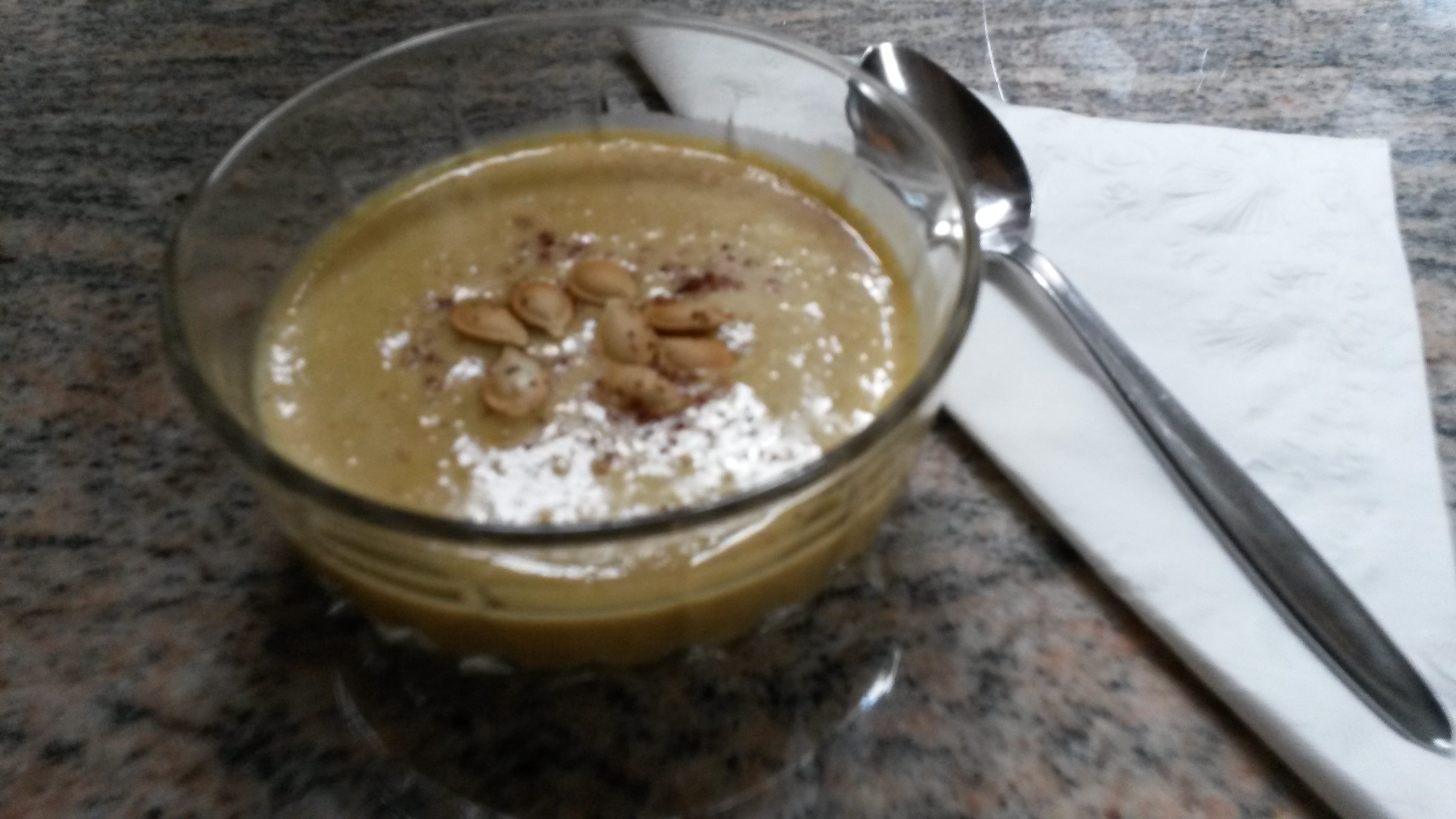
MINI-PUMPKIN SOUP

  1. Slice pumpkins and remove seeds (reserve seeds for garnish)
  2. Bake pumpkins in foil-covered dish with 1″ of water for 1-hour at 350 degrees
  3. Meanwhile, separate the seeds from the fibrous strands and soak in salt water for 15 minutes
  4. Bake seeds in toaster oven for 30 minutes at 325 degrees or until they are browned and crunchy
  5. Scrape pumpkin meat away from the skin (mini-pumpkins above made 2.5 cups)
  6. Make roux of 1/2 stick butter, 1/4 cup flour, 1 cup vegetable bouillon, 1 cup milk or half & half
  7. Add pumpkin meat, season with 1/2 t. salt, 1/2 t. ground cinnamon, 1/2 t. ground nutmeg 1/4 t. ground cloves to taste
  8. Transfer to blender and puree; if too thick, add more milk or half & half
  9. Return to roux pot to reheat or store soup in the fridge and reheat later or serve chilled
  10. Serve in small bowls; garnish with toasted pumpkin seeds and a sprinkle of nutmeg or cinnamon to taste

20151020_145759_Soup

Food Day hashtags: #greenmeal #foodday2015 #EatGreenMoCo

2015 Food Day in Montgomery County, Maryland

2015/10/16

Food Day Logo

In honor of Food Day this year (officially held on Saturday, October 24th), the Montgomery County Food Council’s Food Literacy Working Group encourages local residents to cook a fresh, healthy, vegetable-centered meal and enjoy it with your family, friends, colleagues, or neighbors. Snap and share a photo of your meal during the week leading up to Food Day and join our media campaign!

The Food Council will be tweeting, gramming, and posting on Facebook and our blog the week of October 20th to share our commitment to this effort. Please help us raise awareness on social media using the official Food Day hashtags, #greenmeal and #foodday2015, and tagging @mocofoodcouncil. Throughout October we will feature resources, recipes, and local Food Day event information on our website and Facebook, Twitter, and Instagram accounts. Please follow us and help to get others involved by sharing, liking, and retweeting our Food Day posts and photos.

Please share this widely! We’d love to see everyone- schools, farms, businesses, hospitals, governmental groups, non-profits, and individuals- participate and spread the word about greening our plates to improve our health and the health of our planet.

Follow us and share!:
Web: http://www.mocofoodcouncil.org
Facebook: facebook.com/mocofoodcouncil
Twitter: MoCoFoodCouncil
Instagram: MoCoFoodCouncil

Respecting Religious Diversity

2015/09/15

I am retired and seem to be busier than ever.  As a result, I have neglected my Blog for quite some time.  I have much to say but find no time to say it.  However, the announcement below caught my attention and I have decided to share it with you.

Terminology

MCPS — Montgomery County [Maryland] Public Schools

FCWG — Montgomery County [Maryland] Faith Community Working Group, a public-private partnership promoting social cohesion and public safety

Guidelines for Respecting Religious Diversity

“Guidelines for Respecting Religious Diversity” is a family guide that includes many Board of Education policies and MCPS regulations and procedures that address issues of religious diversity, with feedback elicited from multiple stakeholders throughout both the faith community and MCPS.  This is a historic document – never released before in Montgomery County – and perhaps the first in the nation of its kind.

The collaboration between MCPS and FCWG is a great example of the Montgomery County Model in action, and highlights how successful community led initiatives can be in building trust between various stakeholders in the community.

The Guidelines for Respecting Religious Diversity are now available online.  They are available in 9 different languages.
http://www.montgomeryschoolsmd.org/info/religiousdiversity/

Life Verses

2013/10/02

In one of her small groups icebreakers, Keri Wyatt Kent asks group members to write their “Life Verse” on an index card and then share their verses and explain why it’s significant to them.  So, here are a few verses that are important to me.

Isaiah 6:8 (NIV)
Then I heard the voice of the Lord saying, “Whom shall I send? And who will go for us?” And I said, “Here am I. Send me!”

Many people shy away form the “E-word”, evangelism, and prefer to call it outreach or other such thing.  In any case, the church is he only organization that is established for the sake of those who are not yet members. I have been involved with the Alpha Course for 10, going on 15 years. It is not just a good bible study for the congregation but, when used properly, can be a very effective tool for outreach beyond the walls of the church.  A stagnant or dying church is characterized by an inward focus on their members.  A growing church looks outward, sharing the Good News with others.

1 Thessalonians 5:16-18 (KJV)
16 Rejoice evermore.
17 Pray without ceasing.
18 In every thing give thanks: for this is the will of God in Christ Jesus concerning you.

1 Thessalonians 5:16-18 (MSG)
16-18 Be cheerful no matter what; pray all the time; thank God no matter what happens. This is the way God wants you who belong to Christ Jesus to live.

As you can see, I like to compare bible translations and see which wording speaks to me.  The Message is a paraphrase rather than a literal translation but that doesn’t matter to me.  Prayer is important; for example, I prefer the traditional “pray without ceasing” to the more contemporary “pray all the time” but that does not necessarily mean I’m stuck in the past.  I generally have a positive attitude and like The Message’s “be cheerful no matter what”.

Matthew 9:35-38 (NIV)
The Workers Are Few
35 Jesus went through all the towns and villages, teaching in their synagogues, proclaiming the good news of the kingdom and healing every disease and sickness. 36 When he saw the crowds, he had compassion on them, because they were harassed and helpless, like sheep without a shepherd. 37 Then he said to his disciples, “The harvest is plentiful but the workers are few. 38 Ask the Lord of the harvest, therefore, to send out workers into his harvest field.”

You might think I have come back to the E-word and, yes, that’s true in the church sense of this passage.

On the other hand in this busy world “the workers are few” in many ways.  It’s so much easier to write a check to a charity or a non-profit than to take time to volunteer.  I learned this many years ago from my father; rather than going on vacation, he would take a full week to take our Boy Scout troop to summer camp (more info).  For my son, I helped with Cub Scouts and later as a soccer coach.  Now that I am retired, I have more time to volunteer around the church,  not only as a member of the Call Committee and the person to enter attendance data but with the Lutheran Lay Fellowship and Rainbow Via de Cristo.

What are your life verses?  How do you volunteer your time to better your church and community?


Don’t Forget God While On Vacation

2013/07/02

A vacation or holiday is a specific trip or journey, usually for the purpose of recreation or tourism.    The concept of taking a vacation is a recent invention, and has developed through the last two centuries.  Once the idea of travel and recreation was a luxury of wealthy people alone.  In the Puritan culture of early America, taking a break from work for reasons other than weekly observance of the Sabbath was frowned upon. However, the modern concept of vacation was led by a later religious movement encouraging spiritual retreat and recreation.

I know a pastor who asked his flock to bring home church bulletins from when they were on vacation.  Not only did this encourage them to carve out time for church, but by studying it, he was able to glean an idea or two that he could use.

Every summer my wife and I vacation in New England.  On the way, we stop for lunch with the brothers at Holy Cross Monastery in West Park, New York.  It is the mother house of the Order of the Holy Cross, an Anglican religious order inspired by the Benedictine tradition.  Their primary ministry is to guests on individual and group retreats. There are 5 worship services each day: Matins, Holy Eucharist, Diurnum, Vespers and Compline.  We usually attend noontime Diurnum which is held just before lunch.

When on vacation, stay for fellowship hour or coffee in the narthex and tell people about your home church and where you are from.   That’s an easy conversation starter.

A lapse in our routine can lead us to forget what’s most important.  When you’re out of town, research the local churches and their service times.  Pick one that’s convenient regardless of denomination,  Don’t take a vacation from God; do something spiritual as well as physical while away from your usual routine!

p.s. if you forget to bring a bulletin back with you, at least send a postcard to your church or pastor saying you haven’t forgotten God while on vacation.

Ending Food Waste

2013/06/07

Agriculture Secretary Tom Vilsack is calling on both the public sector and private industry to reduce food waste.  He said the USDA is going to:

  • “Develop a nationwide social media campaign with our partners to focus on precisely what the use by date and the sell by date means so that folks don’t discard food prematurely.”
  • “Continue to use our social media to develop a new food storage application that will give people up to date information on how and best to store food and what constitutes safe or unsafe food.”
  • “Work with our school lunch program to reduce food waste in our schools.”
  • “Look for ways we can increase donations of imported fresh produce that for whatever reason don’t meet our marketing order standards.”

VILSACK SAID THAT WASTING FOOD IS A MORAL ISSUE IN A NATION WHERE THERE ARE HUNGRY PEOPLE.

He said that “part of this is thinking about portion sizes.”

How many times have you gone to a restaurant and have been served much more than you can eat?  My wife has a solution.  She literally cuts her meal in half before she starts and eats exactly half — what will-power!  On other occasions, we order two soups or salads and split one entrée so we have no leftovers.

Vilsack also said that “understanding precisely what the food safety rules are so that you are not discarding food that would otherwise would be healthy and nutritious for your family.”

How many times have you brought home leftovers to weeks later find it hidden in the back of the fridge?  Our solution: take a piece of masking tape and date the container.  Depending on the type of food, throw it out within 3-4 days or a week if it hasn’t been eaten in a timely manner.

There are other things you can do to keep your family safe from foodborne illness.  As the USDA, FDA, CDC and Ad Council public service announcements say: Clean, Separate, Cook and Chill.

4-simple-steps
http://www.foodsafety.gov