Virtual Food Drive

2020/05/29

A traditional church “Food Drive” where members donate canned goods is not cost-effective. When food is purchased by nonprofits from Feeding America food banks like the Capital Area Food Bank or Maryland Food Bank, donation dollars can go much further. Consider a “virtual” food drive instead and send the proceeds to a nonprofit food agency like Celestial Manna.

What is CFAP?

2020/05/23

On April 17, 2020, U.S. Secretary of Agriculture Sonny Perdue announced the Coronavirus Food Assistance Program (CFAP).  This new U.S. Department of Agriculture (USDA) program will take several actions to assist farmers, ranchers, and consumers in response to the COVID-19 national emergency.  President Trump directed USDA to craft this $19 billion immediate relief program to provide critical support to our farmers and ranchers, maintain the integrity of our food supply chain, and ensure every American continues to receive and have access to the food they need.

“During this time of national crisis, President Trump and USDA are standing with our farmers, ranchers, and all citizens to make sure they are taken care of,” Secretary Perdue said.  “The American food supply chain had to adapt, and it remains safe, secure, and strong, and we all know that starts with America’s farmers and ranchers. This program will not only provide immediate relief for our farmers and ranchers, but it will also allow for the purchase and distribution of our agricultural abundance to help our fellow Americans in need.”

CFAP will use the funding and authorities provided in the Coronavirus Aid, Relief, and Economic Security Act (CARES), the Families First Coronavirus Response Act (FFCRA), and other USDA existing authorities.  The program includes two major elements to achieve these goals.

  • Direct Support to Farmers and Ranchers
  • USDA Purchase and Distribution

On top of these targeted programs, USDA will utilize other available funding sources to purchase and distribute food to those in need.

As a food supplier to low-income families and others who are food insecure, this second point is of most interest to us here in the metro DC region of Maryland, District of Columbia and Northern Virginia.

Farmers to Families Food Box Infographic

USDA will partner with regional and local distributors, whose workforce has been significantly impacted by the closure of many restaurants, hotels, and other food-service entities, to purchase $3 billion in fresh produce, dairy, and meat. USDA will begin with the procurement of:

  • $100 million per month in fresh fruits and vegetables
  • $100 million per month in a variety of dairy products
  • $100 million per month in meat products

This “Farmers to Families Food Box Program” will provide a preapproved box of fresh produce, dairy, and meat products to food banks, community- and faith-based organizations, and other nonprofits serving Americans in need.  Although farmers and industry experts feel that CFAP is a woefully inadequate response to both the oversupply of unpurchased produce and the demand for food, food banks, and local food pantries should be thankful for what they can get through this program.

Suppliers will package these products totaling $1.2 billion into family-sized boxes, then transport them to food banks, community and faith-based organizations, and other non-profits serving Americans in need from May 15 through June 30, 2020.  AMS may elect to extend the period of performance of the contracts, via option periods, dependent upon program success and available remaining funds, up to $3 billion.

Any entity that provides to the supplier proof of its 501(c)(3) tax-exempt status or a government entity (e.g. school food authority, Indian tribe) and who can demonstrate that they have the operational and financial capability to receive, store and distribute requested food items is eligible to receive food from contracted distributors.  Through its contracting process, USDA will require that distributors participating in the program maintain records showing their deliveries have occurred to appropriate non-profit organizations.  Non-profit organizations will be responsible for timely distribution of food.  Food banks and other non-profits may work with identified distributors serving their area to assist in the distribution process.

Contractors must submit an invoicing package that indicates the number of boxes delivered, contents of the boxes, and proof of delivery to a non-profit or other organization in the contract.  There are no reporting requirements for the non-profit or government organizations.

USDA will not be purchasing bulk shelf-stable items through the Farmers to Families Food Box Program.  However, through USDA’s existing programs and additional funding provided by Congress USDA will be making additional purchases of these products.  These will include purchases made with Section 32, Families First Coronavirus Response Act and CARES Act funds and made available to the Emergency Food Assistance Program (TEFAP).

In our area, produce and shelf-stable items are available through the Capital Area Food Bank, a member of Feeding America.  The Capital Area Food Bank leads our region’s efforts to provide good, healthy food to people struggling with hunger and food insecurity.  Each year, they source and distribute the food for over 30 million meals.  The Feeding America network is the nation’s largest domestic hunger-relief organization, working to connect people with food and end hunger.  Donors, staff, and volunteers all play an important role in efforts to end hunger in the United States.

RESOURCES

USDA Agricultural Marketing Service Overview
https://www.ams.usda.gov/about-ams

USDA Announces Coronavirus Food Assistance Program, Press Release Number 0222.20 dated 04/17/2020 (accessed 05/23/2020)
https://www.usda.gov/media/press-releases/2020/04/17/usda-announces-coronavirus-food-assistance-program

Farmers to Families Food Box Infographic (pdf) (accessed 05/23/2020)
https://www.ams.usda.gov/sites/default/files/media/FarmerstoFamiliesFoodBox.pdf

The USDA’s Plan to Feed Americans and Pay Farmers Is Not Enough, by Matt Stieb, dated 04/26/2020 (accessed 05/23/2020)
https://nymag.com/intelligencer/2020/04/usda-plan-to-feed-americans-and-pay-farmers-isnt-enough.html

Coronavirus Food Assistance Program FAQ, Last Updated: May 20, 2020 (accessed 05/23/2020)
https://www.farmers.gov/cfap/faq

USDA AMS Farmers to Families Food Box (accessed 05/23/2020)
https://www.ams.usda.gov/selling-food-to-usda/farmers-to-families-food-box

Farmers to Families Food Box Program FAQs, Published 04/27/2020 (accessed 05/23/2020)
https://www.ams.usda.gov/publications/content/farmers-families-food-box-program-faqs

Capital Area Food Bank (accessed 05/23/2020)
https://www.capitalareafoodbank.org

Feeding America (accessed 05/23/2020)
https://www.feedingamerica.org

###

What is TEFAP?

2020/05/10

In 1939, Secretary of Agriculture Henry Wallace consolidated a number of bureaus and programs to create a single agency to carry out a sweeping mission.  The new Agricultural Marketing Service was charged with facilitating the efficient, fair marketing of U.S. agricultural products, including food, fiber, and specialty crops. In 2017, Agriculture Secretary Sonny Perdue announced the realignment of a number of offices within the U.S. Department of Agriculture (USDA).

USDA’s Agricultural Marketing Service (AMS) administers programs that create domestic and international marketing opportunities for U.S. producers of food, fiber, and specialty crops.  AMS also provides the agriculture industry with valuable services to ensure the quality and availability of wholesome food for consumers across the country.

The Emergency Food Assistance Program (TEFAP) is a federal program that helps supplement the diets of low-income Americans, including elderly people, by providing them with emergency food assistance at no cost.  Through TEFAP, the U.S. Department of Agriculture purchases a variety of nutritious, high-quality USDA Foods, and makes those foods available to State Distributing Agencies.

TEFAP foods include dairy products, grain & oilseed products, fruits, vegetables, nuts, beef, bison, lamb, pork, poultry, egg products, fish, and seafood.

USDA makes commodity foods available to States for distribution to low-income people through emergency food providers.  USDA also provides States with funding to assist with a small amount the storage and distribution costs for TEFAP commodities.  The amount of food each State receives out of the total amount of food provided is based on the number of unemployed persons and the number of people with incomes below the poverty level in the State.

TEFAP is a means-tested federal program that provides food commodities at no cost to Americans in need of short-term hunger relief through food providers like emergency food pantries, food banks, soup kitchens and shelters.  Here in the DC region, the Capital Area Food Bank (CAFB) participates in TEFAP.  In Montgomery County, Maryland, Manna Food Center is an authorized distributor of TEFAP food obtained from CAFB.  In the DC region, not just Montgomery County, Celestial Manna is a partner of CAFB and will be applying to become a TEFAP-authorized agency.

Food banks such as CAFB, combine TEFAP commodities and storage and distribution funding with private donations of food and funds, infrastructure, and manpower to leverage the program far beyond its budgeted amount.  In this way, TEFAP and the emergency food system exemplify an optimum model of public-private partnership.

In summary, TEFAP is a federal program that helps supplement the diets of low-income Americans by providing them with emergency food assistance at no cost.  USDA provides 100% American-grown USDA Foods and administrative funds to States to operate The Emergency Food Assistance Program.

REFERENCES (accessed 05/10/2020)

https://www.feedingamerica.org/take-action/advocate/federal-hunger-relief-programs/the-emergency-food-assistance-program

https://www.ams.usda.gov/about-ams

https://www.ams.usda.gov/sites/default/files/media/AMS_Fact_Sheet_2019.pdf

https://www.ams.usda.gov/programs-offices/ams-overview

https://www.ams.usda.gov/selling-food/becoming-approved

https://www.ams.usda.gov/selling-food/solicitations

https://www.fns.usda.gov/tefap/emergency-food-assistance-program

https://www.fns.usda.gov/tefap/tefap-fact-sheet

Pandemic Prayer

2020/04/08

Most merciful God, amidst this global pandemic, you hold each of us dear to your heart. Hold those with Covid-19 in your loving arms and tenderly draw them into your love, together with their loved ones who are praying for their recovery.

From a distance, assure them that they are not alone, and give them courage and faith for all that is to come. Strengthen the first responders and hospital staff who care for them and treat them, and guide those who do research into a cure. Nourish those who have lost sight of you, and heal the spirits of those who are broken.

We pray this in the name of Jesus, who suffered and died, and then rose from the dead to lead us into new life, now and for ever.

Amen.

SOURCE:  Adapted for Covid-19 from the United Methodist Book of Worship, Pastor’s Pocket Edition, 1992

Shrove Tuesday and Lent

2020/02/29

Shrove Tuesday is observed by many Christians, including Anglicans, Lutherans, Methodists and Roman Catholics, who “make a special point of self-examination, of considering what wrongs they need to repent, and what amendments of life or areas of spiritual growth they especially need to ask God’s help in dealing with.”

Shrove Tuesday is exactly 47 days before Easter Sunday, a moveable feast based on the cycles of the moon. The date can be any between 3 February and 9 March inclusive. Shrove Tuesday in 2020 occurs on February 25.

The expression “Shrove Tuesday” comes from the word shrive, meaning “absolve”. This word began when the Latin verb scribere (meaning “to write”) found its way onto the tongues of certain Germanic peoples who brought it to Britain in the early Middle Ages. Because it was often used for laying down directions or rules in writing, 8th-century Old English speakers used their form of the term, scrifan, to mean “to prescribe or impose.” The Church adopted scrifan to refer to the act of assigning penance to sinners and, later, to hearing confession and administering absolution.

As this is the last day of the Christian liturgical season historically known as Shrovetide, before the penitential season of Lent, related popular practices, such as indulging in food that one might give up as their Lenten sacrifice for the upcoming forty days, are associated with Shrove Tuesday celebrations. The term Mardi Gras is French for “Fat Tuesday”, referring to the practice of the last night of eating richer, fatty foods before the ritual fasting of the Lenten season, which begins on Ash Wednesday. Many Christian congregations thus observe the day through the holding of pancake breakfasts, as well as the ringing of church bells to remind people to repent of their sins before the start of Lent.

“The Bruton Fount” Spring 2020 Issue from Bruton Parish Church in Williamsburg, Virginia, cites the February calendar published in the 1774 Virginia Almanack with these lines:

You Friends, who late on Pancakes Far’d,
For Fasting now must be prepar’d,
‘Cause ‘tis the holy Time of Lent;
Of all your Sins you must repent,
And you will find your Time well spent.


SOURCES (accessed 02/29/2020)

Wikipedia Article on “Shrove Tuesday”
https://en.wikipedia.org/wiki/Shrove_Tuesday

Merriam-Webster Online Dictionary Article on “shrive”
https://www.merriam-webster.com/dictionary/shrive

Spring 2020 Issue of The Bruton Fount, Bruton Parish Episcopal Church, Williamsburg, Virginia. p.5
http://images.acswebnetworks.com/1/1318/BPCFOUNTSPRING2020.pdf


Dedicated volunteer drivers are the life-blood of Celestial Manna

2019/11/17

Forty percent of all food in the United States goes to waste! It’s not that there isn’t enough food produced, it’s just not always in the right place at the right time or not quite good enough for a high-end market to sell.

Some food has slight imperfections, is perfect but too small or too large, or is perfect but surplus. Many times a farmer will plow produce under or feed it to their animals if it can’t be sold.

Perfectly good food at the grocery store that is near it’s “best by date” is often thrown away. Volunteer drivers from Celestial Manna routinely go to farms and grocery stores to pick up food that would otherwise be discarded. Some food is then delivered directly to families in need; some is delivered to church and community food pantries; some is delivered to food banks such as Montgomery County’s Manna Food Center and Nourish Now.

Celestial Manna has around 175 volunteer drivers who move 5 million pounds of food a year from farms and grocery stores to places where it can be used to feed the hungry. On top of their volunteer time, they generally use their own cars and pay for their own gas.

Celestial Manna would not have survived over 30 years without their dedicated crew of volunteer drivers.

About Celestial Manna

Celestial Manna is a 501(c)(3) nonprofit established in 1987. Their primary mission is to feed the hungry by providing them with free food which is locally donated. They give weekly support to more than 10,000 people in the Washington, DC metropolitan region stretching from north of Baltimore through Prince George’s and Montgomery Counties Maryland, and south to northern Virginia. Celestial Manna tries to help people from all walks of life; these individuals range from blue-collar workers, low-income families, single-parent households and diverse ethnicities. Hunger is not the only challenge these people face. In addition to a network of food redistribution, Celestial Manna provides support to people in need of clothing, furniture, toys, and household goods.

For more information, visit http://www.CelestialManna.org or call (240) 350-1456. Combined Federal Campaign (CFC) number 76440. GuideStar Platinum Seal of Transparency, EIN number 01-0588746.

All Saints’ Day

2019/11/04

All Saints’ Day, also known as All Hallows’ Day, Hallowmas, the Feast of All Saints, or Solemnity of All Saints, is a Christian festival celebrated in honor of all the saints, known and unknown. In medieval England, the festival was known as All Hallows, and its eve is still known as Halloween.  The period from October 31 to November 2 (All Souls’ Day) is sometimes known as Allhallowtide.  On All Saints Day, it is common for families to attend church, as well as visit cemeteries in order to lay flowers and candles on the graves of their deceased loved ones.

The Christian celebration of All Saints’ Day and All Souls’ Day stems from a belief that there is a powerful spiritual bond between those in heaven (the “Church triumphant”), and the living (the “Church militant”).  In the Lutheran churches, such as the Church of Sweden, it assumes a role of general commemoration of the dead.  In the Swedish calendar, the observance takes place on the Saturday between 31 October and 6 November.  In many Lutheran Churches, it is moved to the first Sunday of November.

Augustinian monk, Father Martin Luther, Professor of Scripture, posted the 95 Theses on October 31st, for an academic discussion on the practice and selling of indulgences.  The Church’s doors were used as a kind of bulletin board for events in the city.  Luther chose October 31st because the next day, All Saints Day, many townspeople would be coming to All Saints Church for the Mass. Today, All Saints Day is the day to remember all the saints, living and dead.
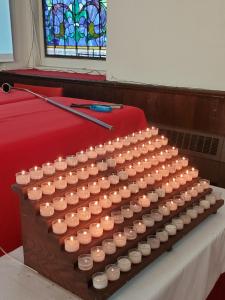
At church on All Saint’s Sunday, November 3, 2019, members of the congregation were invited to come forward to light a candle in honor and/or in memory of the saints in their lives; such as parents, grandparents, teachers, as well as those loved ones who have passed away.  Earlier in the service, the pastor explained that all Christians are saints. By lighting three candles, I specifically remembered my family, my in-laws family and a friend, Gerry Schueman.


Gerald Martin Schueman
May 27, 1936 – July 3, 2019

God of many nations, we celebrate the life of your servant Gerry, born 92% German, 8% Finnish and adopted as 100% Swedish by Sweden House.  His mother’s father immigrated to the United States and established Lutheran churches in the Dakotas.  There is much concern in northern Europe and Scandinavia with changes in the economy. Alleviate the uncertainty due to Brexit and bring all people together.  Jesus said to welcome the stranger. (Matt 10:40)  Look with favor on all newcomers to America.

Jesus, you said to welcome the stranger and feed the hungry. (Matt 10:40, 25:37)  Gerry contributed his time, talents, and resources, both goods and money, to those in need.  He was a wordsmith that attracted others to the varied organizations he supported.  Gerry’s dedicated efforts for his favorite organizations brought joy to many and his presence will be greatly missed.

Holy Spirit, you are our guide and comforter. (John 14:15-17)  When in the Navy, Gerry was a Protestant Lay Leader for his ship.  As a mentor to boys, he guided them to the successful completion of their Eagle Badge projects.  Gerry was in heaven whenever he was on the local Trail, Pimmit Run; whether he was walking his dog, trimming the trail, or building steps to cross the creek.  Holy Spirit, look with favor on your servant who will be greatly missed here on Earth.

Jesus said, “I am the resurrection and the life. The one who believes in me will live, even though they die; and whoever lives by believing in me will never die.” (John 11:25-26)  The Lamb at the center of the throne will be their shepherd; he will lead them to springs of living water.  And God will wipe away every tear from their eyes. (Revelation 7:17)  Paul said, “Praise be to the God and Father of our Lord Jesus Christ, the Father of compassion and the God of all comfort, who comforts us in all our troubles, so that we can comfort those in any trouble with the comfort we ourselves receive from God.” (2 Corinthians 1:3-4)

We, who are the friends of Gerry, lift up his family to you.  We ask for your supernatural protection and love to shower over them.  We ask for you to carry them through these days of deep grieving.  Draw this family together as they move through their sadness and grief.  Lord, we pray that this family can easily feel our love extended toward them.  As friends of the family, remind us to stand by this family and pray for this family.  Help us to find ways of extending companionship and expressing support.

Lord, look with compassion on those who grieve, especially Gerry’s wife Margaret, daughter Angela, son Greg, brother Kenneth, three granddaughters, and many other relatives and close friends.

Grant them the assurance of your presence now and faith in your eternal goodness, that in them may be fulfilled the promise that those who mourn shall be comforted.  We ask this through Jesus Christ our Lord, who lives and reigns with you and the Holy Spirit, one God, for ever and ever.

Amen.

SOURCES

All Saints’ Day
https://en.wikipedia.org/wiki/All_Saints%27_Day
(accessed 11/03/2019)

On All Saints Day: in 1517 and Today, November 1, 2016
https://concordiaandkoinonia.wordpress.com/2016/11/01/on-all-saints-day-in-1517-and-today/
(accessed 11/03/2019)

Bible Gateway, New International Version
https://www.biblegateway.com
(accessed 09/28/2019)

7 Soothing Funeral Prayers for Family and Friends, Prayer #5, Nov 6, 2018
https://connectusfund.org/7-soothing-funeral-prayers-for-family-and-friends
(accessed 09/28/2019)

United Methodist Book of Worship
Pastor’s Pocket Edition, page 73
The United Methodist Publishing House, 1992

Book of Common Prayer
The Episcopal Church, September 1979

Bible Promises for You
Zondervan, 2005

The New Encyclopedia of Christian Quotations
Baker Books, 2000

Shaping the Prayers of the People, the art of intercession
William B Eerdmans Publishing Company, 2014

Meeting with Margaret Schueman
Tyson Corner, Virginia, 09/29/2019

Collect for Purity

2019/09/12

The Collect is a short opening prayer in a service of worship before the Epistle is read. It may be an invocation, petition, or an affirmation of God’s glory. In the Methodist Church, it is a short prayer with a very precise form. It contains an address to God referring to some attribute of God, a petition relating to that attribute, a reference to the desired results of the petition, and closing words stating that the prayer is through Jesus Christ. The term is derived from the gathering of private petitions from several members of a congregation into a single public prayer. The collectar is a medieval liturgical book containing the collects used in Divine Offices. There are many Collects published in the Episcopal Church’s Book of Common Prayer.

The following Collect for Purity is an ancient prayer.

Deus Cui omne cor patet, et omnis voluntas loquitur, et Quem nullum latet secretum; purifica per infusionem Sancti Spiritus cogitationes cordis nostri; ut Te perfecte diligere, et digne laudare mereamur. Per Christum Dominum nostrum. Amen.
Sarum Sacramentary (Latin, c. 1085)

God, unto whom alle hertes ben open, and unto whom alle wille spekith , and unto whom no privé thing is hid : I beseche thee so for to clense the entent of myn heart with the unspekable gift of thi grace that I may parfiteliche love thee, and worthilich preise thee. Amen.
Introduction to The Cloud of Unknowing (14th Century)

Almighty God, unto whom all hearts be open, all desires known, and from whom no secrets are hid; Cleanse the thoughts of our hearts by the inspiration of thy holy spirit, that we may perfectly love thee, and worthily magnify thy holy name: through Christ our Lord. Amen.
Book of Common Prayer (Traditional, 1549)

Almighty God, to you all hearts are open, all desires known, and from you no secrets are hid: Cleanse the thoughts of our hearts by the inspiration of your Holy Spirit, that we may perfectly love you, and worthily magnify your holy Name; through Christ our Lord. Amen.
Book of Common Prayer (Contemporary, 1979)

Prayer of the Harvest

2019/09/12

Lord of the fields, the Bible says that when a farmer reaps the harvest of the land, they should not reap the very edges of the field or gather the gleanings of the harvest.

Jesus, you said the harvest is plentiful but the workers are few and to love your neighbor as yourself.

Today in America, 40% of all food goes uneaten. Send modern-day gleaners to grocery stores and restaurants to gather food that would otherwise go to waste. Fill our food pantries with your bountiful harvest and love for the needy and stranger among us.

In your precious name, we pray.
Amen.

Cooperation Among Church Denominations

2019/06/27

Sometimes people ask “What are you?” meaning what church do you attend in which denomination or what is your religious background.  Sometimes I don’t know exactly how to answer this question because I have such a varied church background.

I first attend, or at least I thought so at the time, a very old Congregational church in my home town of Wethersfield, Connecticut, founded in 1634.  Then I worked for IBM in the Fishkill/Poughkeepsie, New York area where neighbors invited me to join their Dutch Reformed church.  A work-related transfer took me to Montgomery County, Maryland where I drifted, so to speak from a church perspective, and later joined a United Methodist church.  My wife and I now are ELCA Lutherans.

Back to the beginning of my church life, I will digress with a short story.  Nearly twenty years ago, soon after my mother passed away in 1999, I enquired as to what church my parents were married in.  The answer was “the stone church at the top of the hill on Farmington Avenue” in West Hartford Center.  I wasn’t surprised because both of my parents grew up in West Hartford.  I vaguely remembered that they had an apartment near the center before buying their first “starter” house in Wethersfield.

I found the church office and asked if there was any documentation they might find related to Charles Lambert and Virginia Landegren.  They said they would look into it and get back to me.  I returned home to Potomac, Maryland and a week later I received a phone call; they had found my parent’s Marriage Certificate!  They continued saying there were two more “Lamberts” in their files, Charles and David.  I replied, yes, Charles was my father and I’m Dave but what am I doing in your church records?  The surprising answer was “You were both Baptized on the same day.”  Therefore, add Episcopalian as the absolute first of my church affiliations.

A mongrel dog is a dog that is not definable by type or breed.  In informal settings, I sometimes say I am a “Mongrel Christian.”  In more formal situations I say I am a “follower of Jesus” and let the enquirer take that as a good enough answer or an opportunity to open the door to ask more specific questions.

The meaning of “full communion” between two churches is described in the United Methodist Book of Discipline, paragraph 2401:  Full communion describes the relationship between two or more Christian churches that (1) recognize in each other the one, holy, catholic and apostolic faith as expressed in the Holy Scriptures and confessed in the church’s historic creeds; 2) recognize the authenticity of each other’s baptism and eucharist and extend sacramental hospitality to each other’s members; 3) recognize the validity of their respective ministries; 4) recognize the full interchangeability and reciprocity of all ordained ministers in each of the churches.  That relationship commits the churches to working together as partners in mission toward fuller visible unity.  A relationship of full communion does not mean there are no differences or distinctions between the churches but does mean that these differences are not church dividing.

The ELCA has a similar definition on their Full Communion Partners web page:

  • common confessing of the Christian faith
  • mutual recognition of Baptism and a sharing of the Lord’s Supper, allowing for joint worship and an exchangeability of members
  • mutual recognition and availability of ordained ministers to the service of all, subject to the disciplinary regulations of other denominations
  • common commitment to evangelism, witness and service
  • means of common decision-making on critical common issues of faith and life
  • mutual lifting of any condemnations that exist between denominations.

The UMC is the ELCA’s sixth and most recent full communion partner.  The following scripture passage is located at the bottom of this web page:

Consequently, you are no longer foreigners and aliens,
but fellow citizens with God’s people and members of God’s household.
Ephesians 2:19

Timothy Whitaker said in 2009: “As Lutherans and United Methodists begin to come closer together, we Methodists should tell the story of how our church fathers, Charles and John Wesley, experienced assurance of their justification by grace through faith.  Both Charles and John encountered the writings of Martin Luther at the time they had their life-changing experiences.  Charles was moved by Luther’s Preface to the Epistle to the Galatians, and John was moved by Luther’s Preface to the Epistle to the Romans.”

Leaders of The United Methodist Church and the Evangelical Lutheran Church in America are discussing ways the two denominations can work together as they further explore what it means to be in full communion with each other.

“We share a lot of issues in common that are very, very important to us,” said Doug Ruffle, Associate Executive Director of Path 1, host of a day-long meeting in 2015 with ELCA representatives.  “They include … ways to better equip leaders for leadership in the 21st century …”  The Rev. Dr. Stephen Bouman, Executive Director of Congregational and Synodical Missions said: “Both denominations have gifts to give and to receive.”

“Unity is a gift that we’ve already received in Christ,” said Kathryn Lohre, ELCA assistant to the presiding bishop in North Carolina and executive for ecumenical and inter-religious relations. “Our task as churches is to make that visible and to work toward reconciliation where people have sought to divide what Christ has already united.”

The UMC Ministry of the Laity is the work of mission or ministry to which each believer is called.  As Christians, we are all called to this ministry or priesthood – not just clergy. Each of us has a responsibility to proclaim the Good News and reach out to others in love.  I once heard that 99% of people are laity and 1% are clergy.

As a Certified Lay Speaker in the Baltimore-Washington Conference of the UMC (2001-2007), I am aware of the excellent training resources that are available.  In recent years, the UMC has broadened the program and rebranded it Lay Servant Ministries.  There are now three categories: Certified Lay Servant, Certified Lay Speaker and Certified Lay Minister.

United Methodist Lay Servants are to serve the local church or charge in any way in which their witness or leadership and service inspires the laity to a deeper commitment to Christ and more effective discipleship. This includes the interpretation of scriptures, doctrine, organization, and ministries of the church.  Of course, some material is of a denominational nature but many courses and resources are generic Christian in nature and can be used by another denomination with little or no tailoring.

Because Jesus came to serve, not to be served, it is our duty to learn as much as we can about the Christian faith so we can serve God and our neighbor to the best of our ability.  Cooperation between denominations, especially those in full communion, should be emphasized.  One such way would be for full communion partners to recognize programs and resources for laity as they now do for the mutual recognition of clergy.


REFERENCES

Full Communion Between Lutherans and United Methodists (UMC, Timothy Whitaker, 9/18/2009, accessed 6/26/2019)
https://www.flumc.org/blogdetail/653124
Note: On the UMC Council of Bishops website (accessed 6/26/2019) I was unable to find the article Building a Relationship UMC-ELCA that was cited in the blog referenced above.
http://www.gccuic-umc.org

Full Communion Partners (ELCA website, accessed 6/26/2019)
https://www.elca.org/Faith/Ecumenical-and-Inter-Religious-Relations/Full-Communion

United Methodists and Lutherans Look for Ways to Work Together (UMC Discipleship Ministries 7/28/2015, accessed 6/26/2019)
https://www.umcdiscipleship.org/resources/united-methodists-and-lutherans-look-for-ways-to-work-together

Stronger together — ELCA congregations find vitality through full-communion partnerships (Living Lutheran, Robert C. Blezard, 8/10/2018, accessed 6/26/2019)
https://www.livinglutheran.org/2018/08/stronger-together/

Ministry of the Laity (UMC website accessed 6/26/2019)
https://www.umcdiscipleship.org/leadership-resources/ministry-of-the-laity

Lay Servant Ministries (UMC website accessed 6/26/2019)
https://www.umcdiscipleship.org/leadership-resources/lay-servant-ministries

Lay Servant Ministries Catalog (UMC 2017, updated January 2019, accessed 6/26/2019)
https://www.umcdiscipleship.org/resources/lay-servant-ministries-catalog

Lay Servant Ministries Course Descriptions and Equipping Resources (UMC 2019, accessed 6/26/2019)
https://gbod-assets.s3.amazonaws.com/legacy/kintera-files/laity/LayServant2019_NOCROPS_LORES_bookstore.FINAL.pdf

ELCA-UMC Frequently Asked Questions (ELCA website, accessed 6/26/2019)
http://download.elca.org/ELCA%20Resource%20Repository/ELCA_UMC_Frequently_Asked_Questions.pdf